What Saline Solution Is Designed to Do
The label may look almost too simple: saline, salt water, sterile. Yet the purpose is usually practical rather than medicinal. A saline product is designed to match the body’s fluids closely enough that it can moisten, rinse, or flush without the sharp sting that plain water or a stronger salt mixture may cause. That makes it useful for loosening dried nasal mucus, washing away surface debris, or gently rinsing a minor area of skin.
What it is meant to do depends on the container as much as the liquid. A fine nasal mist is made for short, repeated moisture; a wound-wash bottle is shaped for flushing; contact-lens saline has its own handling expectations and is not automatically a cleaning or disinfecting product. The common misunderstanding is that “saline” describes one interchangeable solution. In everyday use, the concentration may be similar, but sterility, additives, packaging, and directions can make one product a poor fit for another routine.
Different Uses Depend on Sterility and Purpose
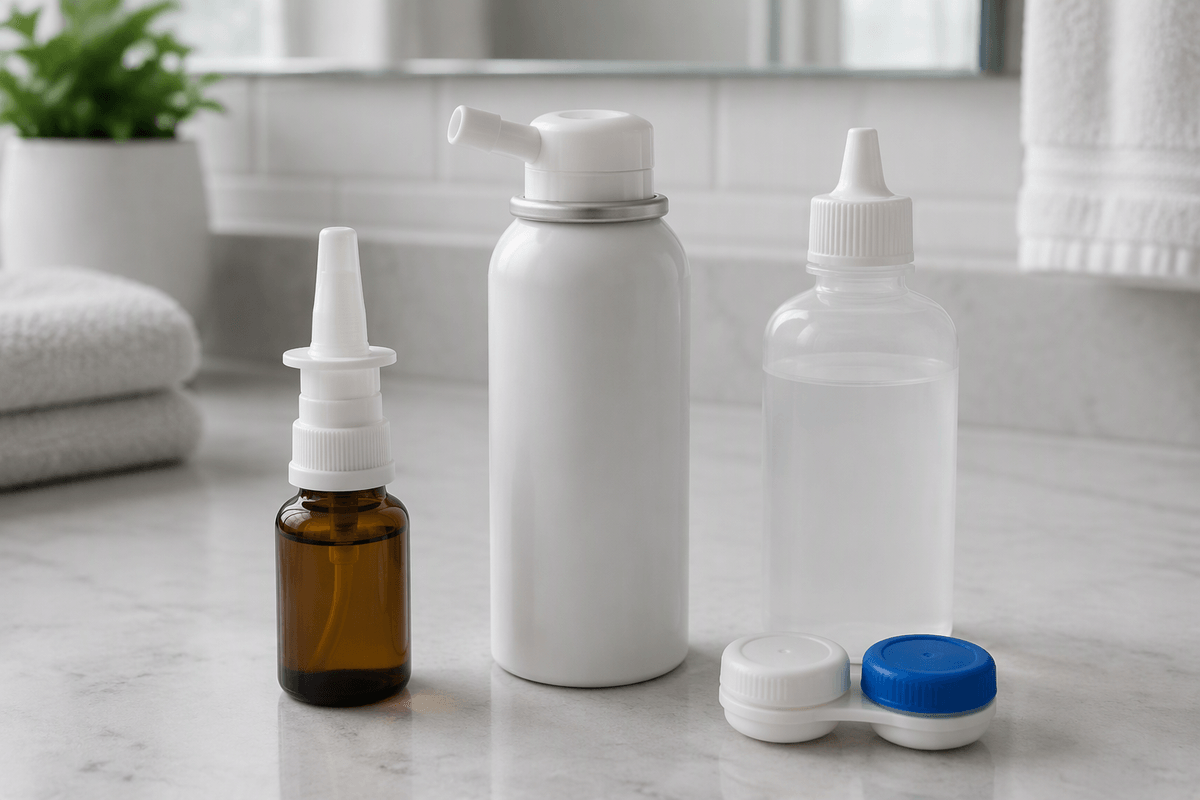
It is easy to reach for the bottle already in the cabinet, especially when the liquid looks clear and the word “saline” appears on the front. But a nasal spray, a pressurized wound wash, and a contact-lens product are packaged around different assumptions. A nasal product may be sterile when sealed but is meant for the nose; a wound wash is intended to rinse exposed skin; and contact-lens saline may rinse lenses without disinfecting them. That last distinction can be easy to miss when a lens feels dry or cloudy.
The label is often more useful than the salt percentage alone. “For nasal use,” “wound wash,” “preservative-free,” or “not for disinfection” signals the routine the product was designed to support. Once a multi-use bottle has been opened, sterility also becomes less straightforward because the tip can pick up contamination from fingers, skin, or nearby surfaces. Using a product outside its stated purpose may not always cause an immediate problem, but it can turn a simple rinse into an uncertain workaround.
Nasal Rinsing Clears Mucus and Irritants
A blocked nose can make a quick spray seem ineffective, when the issue is often the amount of liquid rather than the saline itself. A fine mist mainly adds moisture and may soften crusted mucus near the front of the nose. A larger-volume rinse moves through the nasal passages more fully, helping carry out thicker mucus, pollen, dust, and other irritants that have settled there. The relief can feel immediate, but it is usually from clearing and moistening, not from treating the cause of the congestion.
That difference also makes the routine less casual than simply spraying saline. Irrigation bottles, squeeze devices, and neti-style pots need to be kept clean, and the water used to prepare a rinse matters; tap water is not automatically suitable for nasal rinsing unless it has been properly treated according to product directions. Some people also find that a rinse feels uncomfortable when the mixture is too strong, too cold, or pushed through too forcefully. When it stings or leaves the ears feeling pressured, the technique or mixture may be the problem rather than a need for more rinsing.
Technique Can Change Comfort More Than Expected

The slight burn at the nostril or a sudden sense of pressure near the ears can make saline seem like the wrong product, even when the bottle itself is appropriate. With a nasal spray, the angle and force matter: a gentle mist aimed slightly outward is often more comfortable than a hard spray directed toward the middle of the nose. With a squeeze-bottle rinse, pressing too quickly can create an unpleasant rush and leave fluid lingering afterward.
Small details can also change how the routine feels. Solution that is very cold may be harder to tolerate, while a nozzle that touches the skin or nose can make a multi-use bottle less clean for later use. Leaning too far back may send spray toward the throat, where it can taste salty or trigger coughing. None of these reactions necessarily means saline is harmful, but they can make a useful routine feel irritating enough to abandon. When discomfort repeats, it is worth checking the directions, the device, and the way the solution is being delivered before assuming every saline product will feel the same.
Wound Cleansing Has Important Practical Limits
A scrape can look cleaner after a quick rinse, which is often the point of saline wound wash: it helps flush away loose dirt or dried blood without the harsher feel some products cause. For a small, superficial cut or abrasion, the steady stream from a sterile wound-wash can may be easier to use than wiping repeatedly, especially when rubbing would sting or disturb the area.
Still, a cleaner-looking surface does not answer every question about the injury. Saline does not close a cut, remove material that is embedded, or reliably deal with an injury caused by a bite, a dirty puncture, or a deep tear. It also is not a substitute for checking whether bleeding stops with gentle pressure. A nasal spray or opened multi-use bottle may seem close enough in the moment, but it is not the same as a product labeled for wound cleansing. If redness, warmth, swelling, drainage, worsening pain, or trouble moving the area continues, the routine may need more than another rinse.
Homemade Mixtures Create Hidden Safety Questions
The kitchen mixture can seem like the simplest substitute when a saline bottle runs out: salt, water, and a clean-looking container. The difficulty is that “clean-looking” does not necessarily mean suitable for a rinse that will travel through the nose or touch a sensitive area. Measuring can be inconsistent, so a mixture may be too salty and sting or too weak to feel comfortable. Water choice and storage add another uncertainty, particularly for nasal irrigation, where product directions often specify how water should be treated.
Homemade saltwater also does not carry the same sterility or shelf-life assumptions as a sealed wound wash or a single-use saline vial. Leaving a batch on the counter, dipping into it repeatedly, or reusing a bottle can introduce contamination without changing its appearance or smell. That does not make every homemade mixture dangerous, but it does make it a poor substitute for uses that depend on sterile handling. For contact lenses, homemade saline is especially mismatched: rinsing is not disinfection, and an improvised solution cannot replace the labeled lens-care system.
Knowing When Saline Is Not Enough
Sometimes the clue is not the bottle but the fact that the same problem keeps returning. Saline may loosen mucus, add moisture, or rinse away surface debris, yet it cannot explain persistent nosebleeds, severe facial pressure, repeated thick drainage, or symptoms that interfere with sleep and daily activity. In those situations, using more spray or rinsing more often can become a frustrating loop rather than a solution.
The same limit applies to skin and lens care. A wound that will not stop bleeding, has spreading redness or increasing pain, or contains debris that will not rinse out needs more attention than saline can provide. Eye discomfort, redness, light sensitivity, or vision changes should not be managed by repeatedly rinsing with lens saline, especially because rinsing does not disinfect lenses. Saline remains useful for the jobs on its label, but a product mismatch is not always the only issue; sometimes the change in symptoms is the part worth noticing.