Why “steady energy” rarely comes from one food
You grab something “healthy” on the way out—maybe a piece of fruit or a granola bar—and it feels like the responsible choice. Then an hour or two later, your focus starts slipping and your stomach is making noise again. It’s easy to blame willpower, but a lot of the time it’s just the shape of the energy curve you set up without realizing it.
Many quick foods are mostly fast-digesting carbs, which can push blood sugar up quickly and then drop it back down. That drop can feel like fogginess, jittery hunger, or that “tired but wired” restlessness that makes another snack feel urgent. Stress, poor sleep, and coffee can make the swing feel sharper on workdays, so the same food doesn’t always hit the same way.
That’s why “steady energy” usually comes from a combination, not a single hero food. When carbs show up with fiber and a bit of fat or protein, digestion tends to slow, and the rise-and-fall can feel less dramatic. Bananas, oats, and nuts fit into that picture in different ways—but they don’t all solve the same problem on their own.
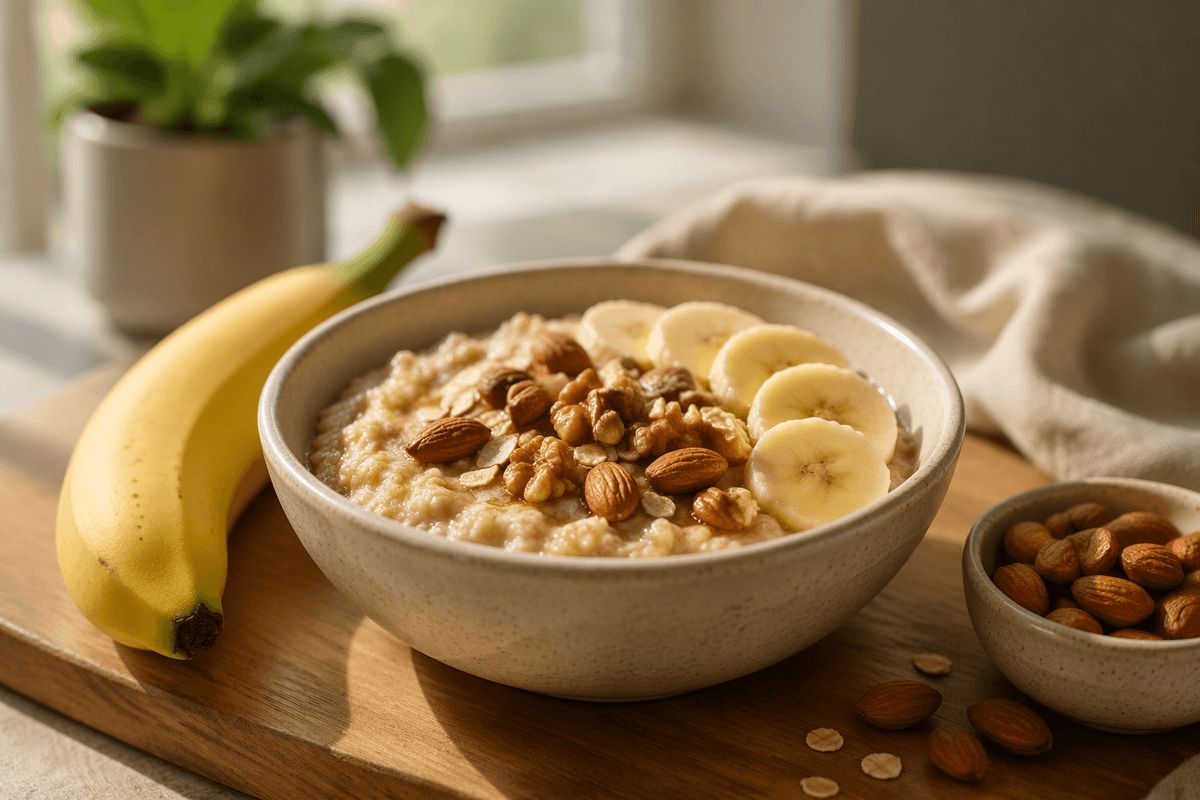
Bananas as quick fuel with built-in pacing
You notice it when you eat a banana in the car or between meetings: it settles your stomach fast, and your brain feels like it’s coming back online. But it can also feel almost too clean—like the fuel shows up quickly, then leaves you looking around for the next thing.
Bananas tend to land in that “quick help” category because their carbs are easy to access. Still, they’re not just sugar in a vacuum. The fiber gives a little pacing, and a slightly greener banana can feel steadier for some people because it’s often a bit less immediately sweet and may digest more slowly.
On a calm morning it might carry you, but on a high-stress day—with coffee, rushed breathing, and a long gap until lunch—the same banana can feel like a match: bright at first, then suddenly gone. That contrast is often what makes bananas feel either perfect or disappointing depending on the day.
Oats create a slower curve through viscosity
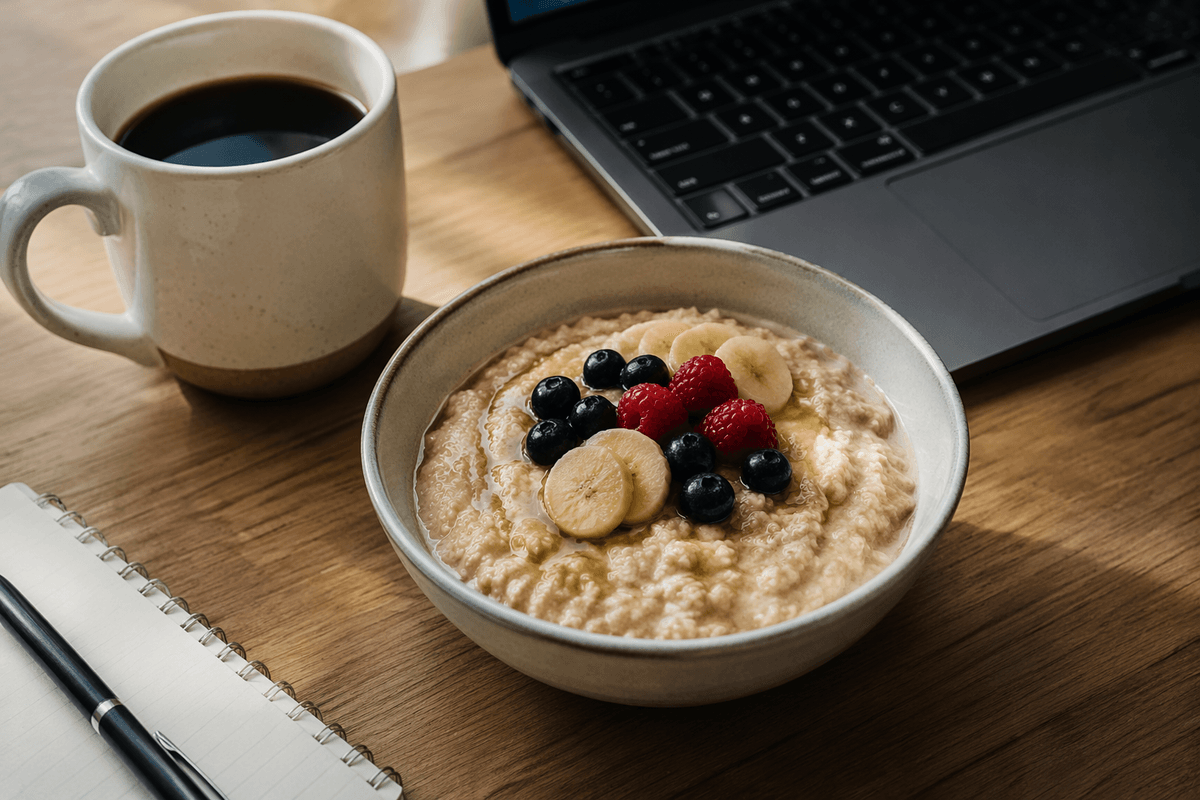
It’s the opposite feeling from the “banana match” when you eat oats and nothing dramatic happens right away. You’re not suddenly energized—you just notice, a bit later, that you haven’t been thinking about food as much. The morning feels less jagged, especially if your first hour is emails, calls, and coffee.
Part of that steadiness comes from how oats behave once they’re wet. The soluble fiber in oats (often talked about as beta-glucan) thickens into a kind of gel, and that viscosity can slow how quickly the meal leaves your stomach and how fast carbs are absorbed. Instead of a sharp rise and a sharp drop, the curve tends to stretch out, which can make focus feel more “held” rather than constantly rescued.
The oats are easy to accidentally turn back into a fast breakfast. Instant packets, blended “drinkable” oats, or loading them with sweet add-ins can make them feel less steady. And some mornings the heavier texture is a dealbreaker—useful, but not always what your body wants.
Nuts blunt spikes but can add hidden friction
A handful of nuts looks like the simplest fix: toss them into oatmeal, keep a bag in your desk, grab them with a banana and move on. And in the moment, it often does feel like the edges get softer—less of that immediate “rush” and less urgency to hunt for another snack right away.
That smoothing effect usually comes from what nuts bring that quick carbs don’t: fat, some protein, and fiber. Those pieces tend to slow stomach emptying and digestion, so the carbs in the meal arrive more gradually. In a mixed snack—banana plus almonds, oats plus walnuts—the energy curve can feel less like a spike and more like a slope you can actually work on.
Nuts are calorie-dense, so it’s easy to overshoot what your body needs without feeling “stuffed,” and that can leave you a little heavy or dull instead of steady—especially mid-morning at a desk. They also digest slowly, which can be a downside if you already feel tight, bloated, or like your breakfast is sitting in your stomach. In some workday patterns, nuts don’t cause a crash—they just make the “steady” feeling arrive later than you expected.
The combination effect: carbs plus fiber and fat

The clue is usually small: you finish your snack, close your laptop, and realize you’re still scanning the kitchen in your mind. Not because you’re starving, exactly—more because the first thing you ate didn’t “stick.” That’s where combinations start to matter, especially on workdays when you don’t get clean breaks to eat again.
Carbs tend to feel best when they’re not traveling alone. A banana gives fast-access fuel, but adding nuts (or pairing it with oats later) changes the pace: fat and protein can slow stomach emptying, and fiber can slow how quickly carbs get absorbed. The result isn’t necessarily more energy—it’s often fewer sharp cues: less sudden hunger, less edgy focus, less that quick swing into “I need something now.”
But the trade-off is that the “steady” version can feel muted. If you’re used to a noticeable lift, a mixed snack can feel like it’s doing nothing—until you realize you’ve made it to late morning without the same urgency. And if the combo is too heavy for your timing, it may feel steady in theory but uncomfortable in practice, like your body is still working on breakfast while your calendar has already moved on.
When a sensible choice still leads to a slump
It’s frustrating when you do the “right” thing—oats with nuts, maybe a banana on the side—and then you still hit that soft wall around 10:30 or 3:00. It can feel like your body ignored the plan: you’re not exactly hungry, but your brain gets slower, your patience gets thinner, and coffee suddenly sounds like a solution again.
Sometimes the slump isn’t from the food being too fast, but from the timing mismatch. A slower combo can spread energy out so gently that you don’t notice a lift, especially if you started the day already under-fueled from short sleep or a rushed morning. In that state, stress hormones and caffeine can prop you up early, and the dip shows up later—less like “low blood sugar,” more like your system finally dropping the scaffolding.
And sometimes the sensible choice is simply too light for the gap you’re asking it to cover. A modest bowl of oats might be steady, but if lunch is far away or meetings erase your usual snack window, “steady” can quietly turn into depleted. The pattern to watch is whether the slump comes with real stomach hunger, or whether it’s mostly fog and restlessness—two different signals that can look the same on a calendar.
Reading your patterns without chasing perfection
You don’t always notice the pattern until a weirdly specific moment—reading the same line twice, or realizing you’ve been “productive” for twenty minutes but haven’t actually finished anything. The easy assumption is that your breakfast “failed,” but workdays aren’t clean experiments. The same oats can feel steady on Tuesday and oddly flat on Thursday, just because sleep, stress, and coffee changed the background noise.
It can help to look for a few repeatable signals instead of a perfect rule. If you feel sharp hunger and stomach emptiness, your meal may have been too small for the time gap. If it’s more foggy and restless—with a kind of snacky impatience—your carbs may have landed too fast, or your first food arrived after your system was already running on adrenaline.
The goal isn’t to engineer a flawless curve. It’s to notice which combinations feel “quietly fine” versus which ones make you start bargaining with the vending machine, and to accept that sometimes the best choice is simply the one that fits your day without sitting heavy.